
Review · UNITED STATES
Big Island Hawaii: Craft Chocolate Tasting and Farm Tour
Chocolate starts as a farm crop. That makes this Hilo experience much more interesting than a simple tasting. I like the orchard-to-bar education and the chance to compare cacao from across Hawaii in one sitting. I also like the setting, with a refined tasting room above the trees and broad views toward the ocean and valley. The main drawback is the price: at $130 per person, this is a serious splurge for anyone who only wants a quick chocolate sample.
You will spend three and a half hours with the crop, not just the finished candy. The tour covers cacao growing, fermentation, chocolate history, and a generous spread of tastings. Bring patience for the winding farm-road arrival, and do not count on a quick rideshare pickup afterward. One recent visitor found it took a long time for the driver to locate the farm.
Key points at a glance
- Ten or more Hawaiian chocolate bars: Compare single-origin bars made from cacao grown on different islands and farms.
- A real working cacao farm: See the trees, pods, harvest process, and fermentation room rather than only hearing a polished chocolate story.
- More than chocolate: Try fresh cacao juice, roasted cacao beans, cacao tea, chocolate-covered macadamias, and seasonal produce.
- A memorable Hilo setting: The tasting room sits above the orchard canopy with ocean and valley views.
- Strong guide-led teaching: Wren and Jude have been praised for clear explanations, warm hosting, and genuine enthusiasm for the work.
- Best for curious adults and older children: The experience lasts 210 minutes and is not suitable for children under nine.
Why this is more than a chocolate tasting
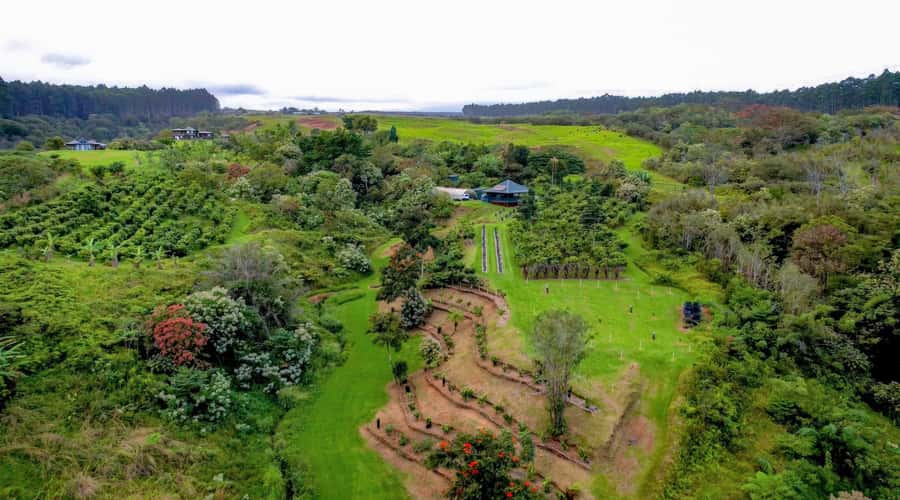
Honolii Orchards is about five minutes from Hilo, but the approach quickly feels rural. You leave the main highway, pass through Paukaa, and climb Puia Road through an older agricultural area shaped by breadfruit, sugarcane, macadamia trees, and cattle land.
That setting matters. You are not being handed a tray of chocolates in a city shop. You are seeing the crop in the place where it grows, with the wider story of Big Island farming around you. The sugar industry once shaped much of the Hamakua Coast, and the tour connects that past with Hawaii’s newer cacao trade.
The experience costs $130 per person, which is not casual sightseeing money. I think the price makes sense if you care about food production, Hawaiian agriculture, or fine chocolate and want a guided session that explains what you are tasting. It is less compelling if your goal is simply to buy a box of local sweets.
The length also helps justify the cost. You receive a farm walk, a look at fermentation, a chocolate lesson, and several food samples during roughly three and a half hours. This is a class with scenery and snacks, rather than a short stop on a busy day.
More Chocolate Tastings in the USA
- Princeville Botanical Gardens Tour and Chocolate Tasting Ticket
★ 5.0 · 774 reviews - Kauai Chocolate Farm Tasting Tour
★ 5.0 · 666 reviews - Nashville’s Goo Goo Chocolate Tasting & Candy Making Class
★ 5.0 · 247 reviews
Finding the farm on Puia Road
Use the provided Google Maps pin rather than relying on general navigation. The directions contain one detail worth knowing: Puia Road is mislabeled as Woa Road in the area. Follow the street names shown by Google Maps, and ignore private-road signs along the route.
From Hilo, head toward Paukaa, Hawaii 96720. Turn from Mamalahoa Highway onto Kulana Street, continue through Paukaa Town, and turn onto Puia Road near the Paukaa Kingdom Hall of Jehovah’s Witness Church. The farm entrance is about 1.7 miles farther up the road, a drive of roughly five to ten minutes.
Look for the open green gate and large vinyl sign on the left. This is not the kind of attraction where you want to arrive at the last minute while watching for a small address marker. Give yourself enough time to make the turn and recognize the entrance.
The remote farm setting is part of the charm, but it affects transportation. One visitor had trouble getting an Uber driver to find the property after the tour. I would arrange your return ride in advance if possible, or make sure your driver has the exact map pin. The farm is close to Hilo by distance, but the final road can still confuse a driver unfamiliar with it.
The orchard walk explains the whole process
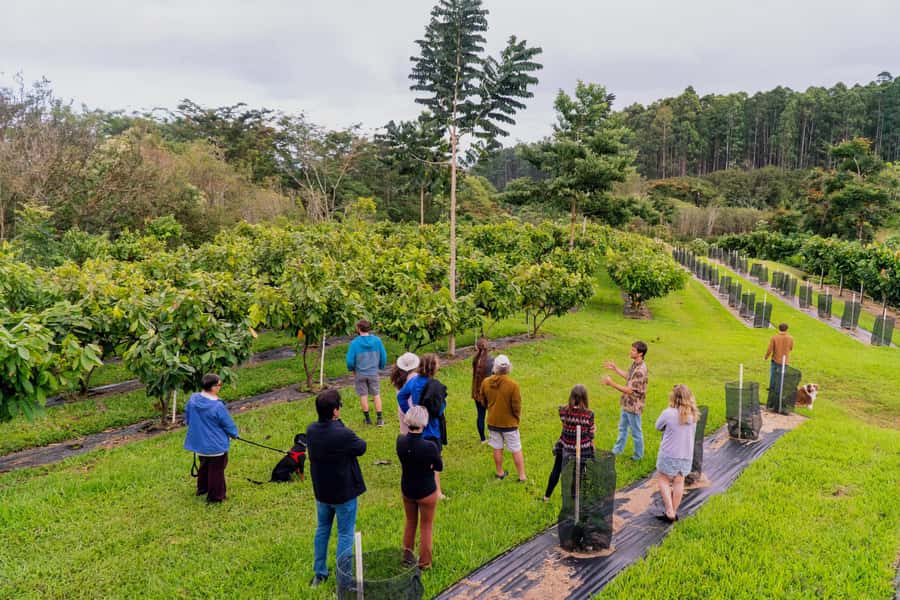
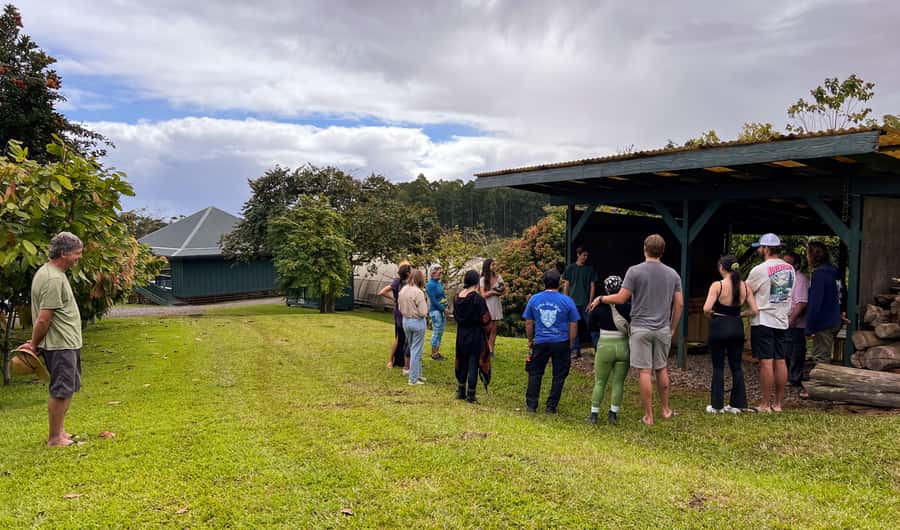
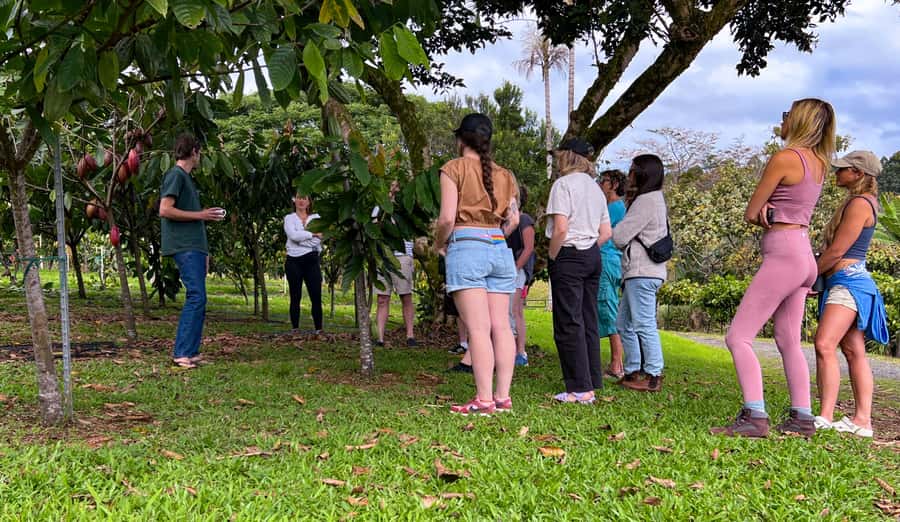
The visit begins with a little conversation and welcome refreshments before you head into the cacao orchard with your guide. That informal start helps the afternoon feel personal rather than rushed.
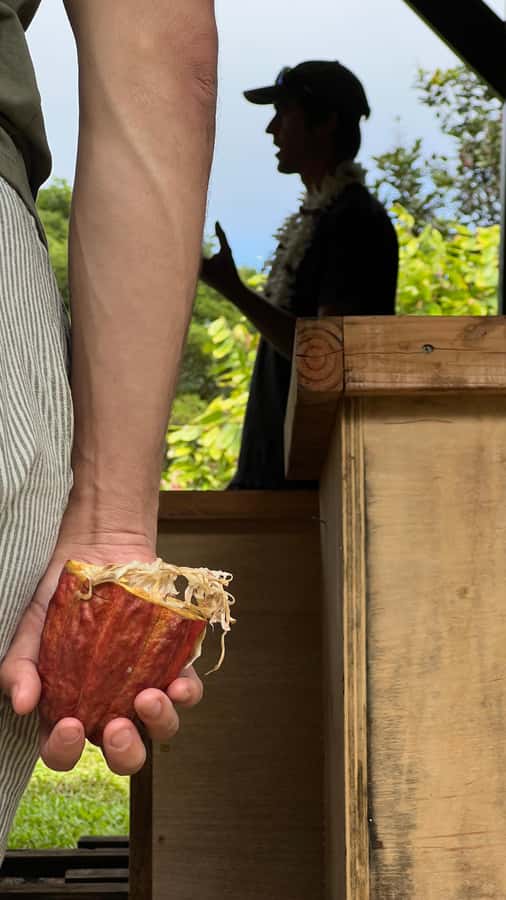
In the trees, you learn how cacao is cultivated and harvested. The value here is seeing the raw material before it becomes a polished bar. Cacao is not a finished food when it comes off the tree. The pod, beans, pulp, fermentation, drying, roasting, and grinding all affect the final flavor.
The guides explain the work in accessible language, which is useful if agricultural science is not your usual holiday subject. One guide was praised for avoiding unnecessary technical terms and explaining each idea in a way that made sense to people speaking English as a second language. You can ask questions throughout the walk, so the experience works for both newcomers and serious food enthusiasts.
The orchard also gives you a better sense of the labor behind craft chocolate. You begin to notice that a bar labeled with a farm or island is not merely a marketing choice. Cacao genetics, soil, weather, harvest timing, and post-harvest handling can all change what ends up in the wrapper.
Do keep your expectations realistic. The farm walk is an educational visit, not a strenuous wilderness hike or a theme-park attraction. If you have trouble standing for long periods or have mobility concerns, tell the hosts in advance. The experience includes walking and time on your feet.
The fermentation room is the key stop
For many people, the fermentation room will be the most valuable part of the afternoon. It is where the tour moves from a pleasant farm visit to a serious food lesson.
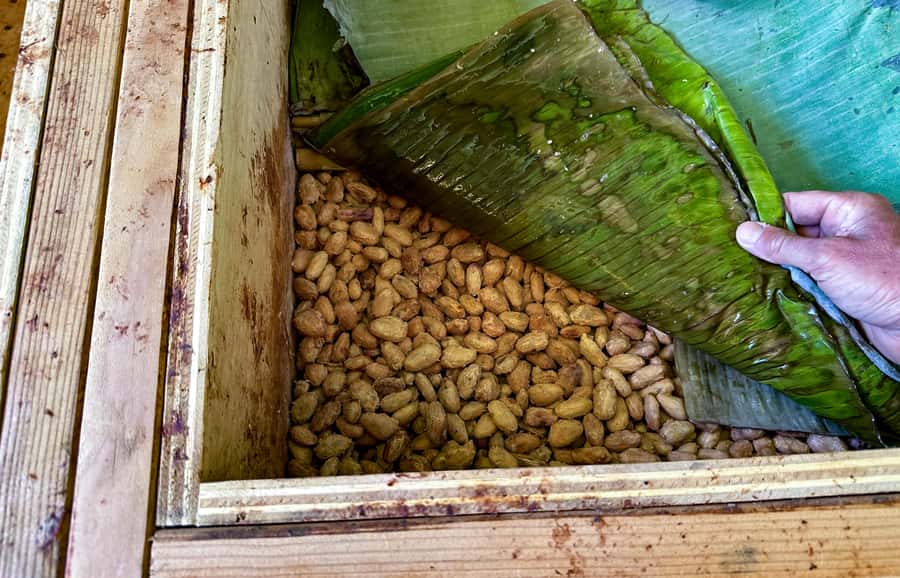
Fresh cacao beans do not taste like a finished chocolate bar. After harvest, they must be handled carefully. Fermentation changes the beans through heat and microbial activity, helping create the flavor foundation that later roasting can develop. Small variations in this stage can produce major differences in the cup or bar.
At Honolii Orchards, the guide explains the post-harvest process and shows how fermentation fits into craft production. This is a step that most chocolate shops skip because it is not visually flashy. Yet it is one of the reasons two bars made from different cacao can taste so different.
I like that the farm treats fermentation as central rather than as a footnote. You leave with a more useful way to judge chocolate. Instead of asking only if a bar tastes sweet, you can start noticing fruit, acidity, roast, bitterness, texture, and finish.
The tour also gives you a look at the agricultural decisions behind the product. The farm is using science to improve its growing and processing methods, and the guides are happy to discuss that work in detail. If you enjoy learning how food is made, this section alone adds real value.
More Cacao Farm Tours in the USA:
- Lahaina: Maui Ku’ia Estate Guided Cacao Farm Tour and Tasting
★ 5.0 · 1,103 reviews - Award Winning Farm Tour: Coffee, Chocolate and Unique Gifts
★ 5.0 · 484 reviews - Lahaina: Maui Ku’ia Estate Guided Cacao Farm Tour & Tasting
★ 4.8 · 137 reviews - Oahu: Chocolate Farm Tour with Tasting – Kamananui Cacao
★ 5.0 · 33 reviews
A short history lesson from Mesoamerica to Hawaii
Back in the tasting room, the focus shifts from farming to chocolate’s long story. The presentation traces chocolate from ancient Mesoamerica to the modern craft movement.
This part gives context to the tasting that follows. You learn how cacao changed from a traditional Mesoamerican food and drink into the wide range of chocolate products sold today. You also look at the difference between craft chocolate and mass-produced chocolate.
The comparison is not simply about declaring one better. Large-scale chocolate is designed for consistency, broad appeal, and efficient production. Craft chocolate places more attention on the source of the cacao, the processing choices, and the flavor differences between batches or farms.
That distinction becomes clearer when you taste the bars side by side. A single bar can be enjoyable on its own, but a flight of bars teaches you more. The order lets you compare flavor profiles rather than relying on memory from a bar eaten weeks ago.
The guides bring plenty of enthusiasm to this section. Wren has been singled out for his passion for cacao and for the work Honolii Orchards is doing to improve local production. That energy matters because chocolate can become a dry lecture if the speaker treats it like a technical manual. Here, the subject remains friendly and approachable.
Ten Hawaiian bars, plus a few surprises
The main tasting includes at least ten single-origin craft chocolate bars sourced from farms across the Hawaiian Archipelago. Some accounts of the tasting included eleven or even fifteen varieties, so the exact number may vary. The firm promise is at least ten.
This is the heart of the experience. Each bar gives you another chance to notice how place, genetics, soil, and climate affect cacao. The point is not to find one universal winner. You may prefer a bright, fruity bar, while someone beside you favors a darker roast or a more rounded finish.
The tasting is also honest about differences in quality and style. One person found some bars good, some less appealing, and some remarkable, which is exactly what you want from a comparative tasting. If every sample tasted identical, the lesson would fail.
You can buy the chocolates you liked after the tour. That is useful because your favorite may not be the one you expected. I suggest keeping a mental note, or asking the guide to identify the bars you prefer as you go. The farm also offers chocolate tea and brewing chocolate for purchase, though those extras are not included in the tour price.
The tasting extends beyond bars. You may try fresh cacao juice, roasted cacao beans, cacao tea, chocolate-covered macadamias, seasonal fruit, and other farm-fresh treats. A chocolate drink served during one visit was especially well received. These additions help you understand cacao in forms that most people never encounter.
Fresh cacao juice is particularly useful as a comparison point. It reminds you that the cacao fruit has its own character before the beans become chocolate. Roasted beans show another stage, while cacao tea offers a gentler drink made from the process.
The tasting room is part of the experience
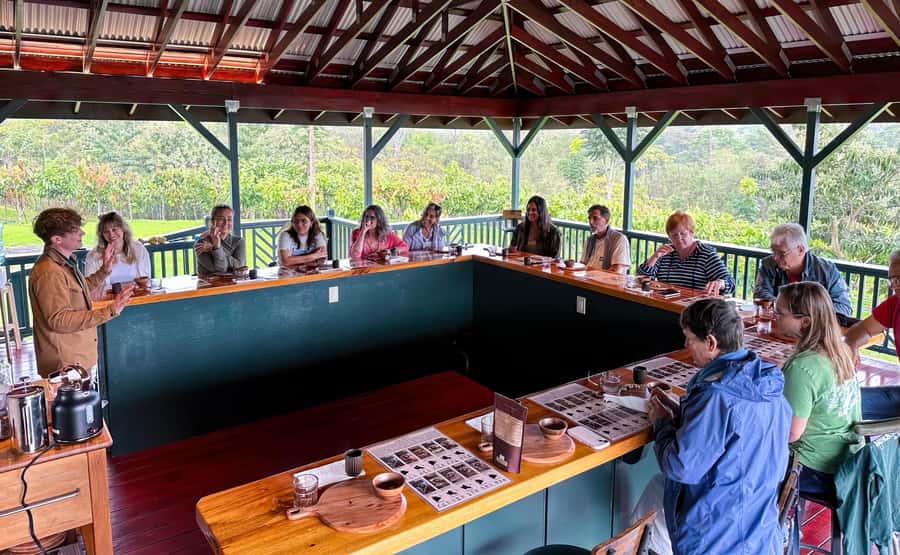
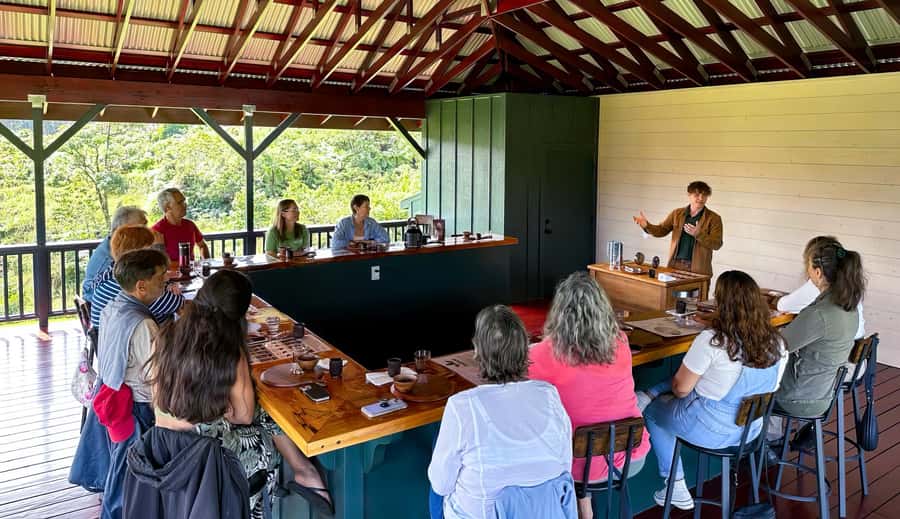
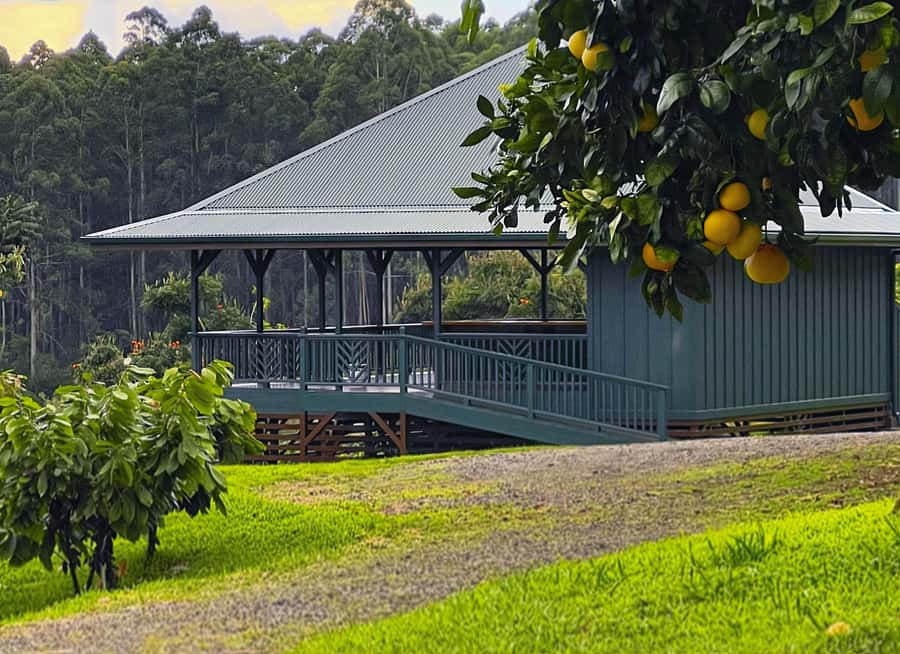
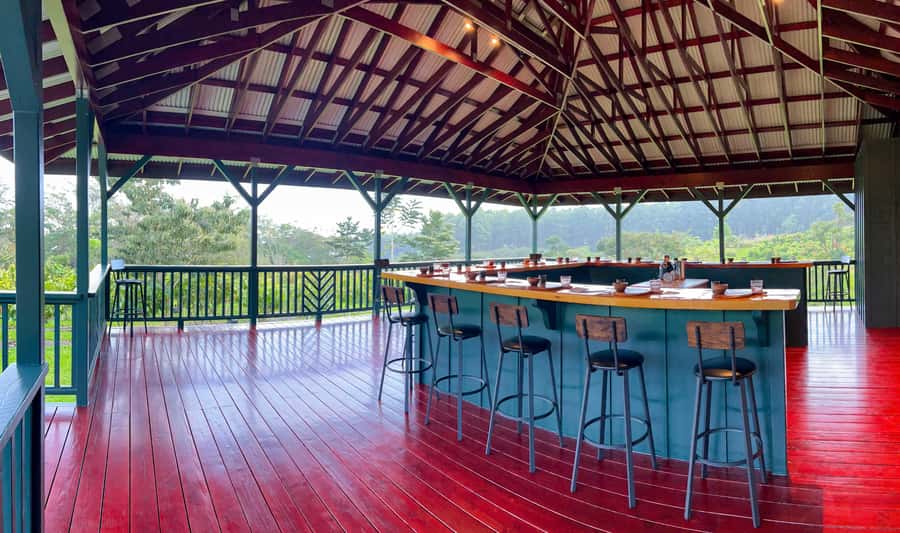
The tasting room sits above the orchard canopy and opens toward ocean and valley views. This gives the afternoon a calm finish after the farm walk and processing lesson.
The setting is polished without losing the connection to the working farm. You can sit, taste, talk, and look across the Hawaiian scenery while the guides explain what is in front of you. That combination helps the experience feel special without turning it into a formal luxury ceremony.
You are also welcome to stay after the scheduled tour, relax in the room, or take a leisurely walk through the orchards. That flexibility is a nice touch if your schedule allows it. You do not have to rush straight back to Hilo the moment the last sample is served.
The open views can be a highlight, but they are also a reminder to dress for an outdoor farm visit. The exact clothing guidance is not specified, so I would choose comfortable clothes and shoes suitable for walking and standing. Avoid bringing large luggage, coolers, strollers, bikes, handcarts, or oversized bags, all of which are not allowed.
Who will get the most from $130
I would recommend this for adults who enjoy food with a story. It is especially well suited to people interested in farming, fermentation, Hawaiian agriculture, or specialty chocolate. The guides are happy to explain details, so you can ask basic questions or go further into production methods.
It can work for families with older children, but children under nine are not allowed. The three-and-a-half-hour duration and instructional parts may be a poor match for anyone expecting a quick, high-energy attraction.
The experience also suits a slower Hilo day. It is close to town, but the farm road and rideshare issue mean you should not squeeze it between tightly timed activities. Plan for the full 210 minutes, plus driving time and a little margin at the end.
People with mobility issues should contact the farm ahead of time. The visit includes an orchard walk and periods of standing, and the hosts specifically ask you to share any concerns.
The tour is conducted in English. The clear explanations have worked well for people who speak English as a second language, but anyone who needs another tour language should not assume one is available.
Booking, cancellation, and practical limits
You can reserve now and pay later, which is helpful if your Big Island schedule is still shifting. Cancellation is free up to 24 hours before the experience for a full refund.
Do not bring weapons, sharp objects, alcohol, drugs, speakers, or smoking materials. Smoking is not allowed indoors or in a vehicle. Unaccompanied minors are not permitted, and the farm does not allow climbing or other listed activities that could create safety problems around the property.
The hosts also ask you not to litter. That may sound obvious, but it matters on a working farm where the visit takes place among crops and rural roads.
Should you book Honolii Orchards?
Book it if you want to understand Hawaiian cacao rather than simply eat Hawaiian chocolate. The combination of orchard, fermentation room, farm history, tasting room, and ten or more single-origin bars gives you a full picture of how flavor is made.
I would skip it if $130 feels too high for an afternoon snack, or if you dislike guided teaching and time on your feet. The experience asks for attention, curiosity, and a reliable plan for getting back to Hilo.
For the right person, this is one of the Big Island’s more distinctive food outings. You leave knowing why cacao farming is difficult, why fermentation matters, and why bars from different Hawaiian farms can taste so unlike one another. That is a lot more useful than simply carrying home another box of candy.
FAQ
Where is Honolii Orchards located?
The farm is at 1533 Puia Road in Paukaa, Hawaii, about five minutes from Hilo. The entrance is 1.7 miles up Puia Road, which is mislabeled as Woa Road in the area.
How long does the experience last?
The experience lasts 210 minutes, or about three and a half hours.
How many chocolate bars are included?
The tasting includes at least ten single-origin craft chocolate bars from farms across the Hawaiian Archipelago. The exact number may vary.
What other foods and drinks are included?
You can sample fresh cacao juice, roasted cacao beans, cacao tea, chocolate-covered macadamias, seasonal fruits, and other farm-fresh treats.
Is the tour suitable for children?
The experience is not suitable for children under nine. Unaccompanied minors are also not allowed.
Is the tour available in English?
Yes. The live tour guide conducts the experience in English.
What should I do if I have mobility concerns?
Tell the farm in advance if you have mobility issues or difficulty standing for extended periods. The tour includes walking through the orchard and time on your feet.
Can I buy chocolate after the tour?
Yes. You can purchase the chocolates tasted during the experience, as well as chocolate tea and brewing chocolate. These purchases are not included in the $130 price.
Just added around the USA
- Waterfall, Chocolate Tour, Rainforest, Royal Historical★ 4.6 · 16 reviews
- Vegas: Taste, Explore & Shop Chocolate Tour★ 3.4 · 16 reviews
- Churches & Chocolate Cart Tour★ 5.0 · 4 reviews
- Savannah History plus Coffee and Chocolate Walking Tour★ 5.0 · 28 reviews
- Santa Barbara’s Ultimate Wine and Chocolate Walking Tour★ 5.0 · 19 reviews
- Make your own Chocolate Bars & Chocolate Box★ 4.5 · 38 reviews
- Santa Fe Chocolate Tasting and History Exploration Tour★ 5.0 · 6 reviews
- Shared Wine, Chocolate and Cheese Tasting in Conesus Lake★ 5.0 · 13 reviews
Chocolate Tastings, compared.
Belgian Chocolate Making Workshop with Tastings
Read our review →
Choco-Story Chocolate Museum Guided Tour w/Tastings
Read our review →
Paris French Sweets Tasting Tour with Pastries and Chocolates
Read our review →
Brussels Walking and Tasting Tour (Beers,Chocolates&Fries/Waffle)
Read our review →
Brussels and Bruges Tour & Optional Chocolate Tasting
Read our review →
Beer Tour with 6 Beers and 3 Chocolate Tastings
Read our review →Browse the lists this tour appears in